

When a “Good Answer” Becomes a Security Risk: Lessons from an Interview
Today I had an interesting experience while interviewing a candidate for an L1 Solution Engineer role.
Technically, the candidate did well. Confident answers, clear explanations, decent understanding—everything you’d expect at this level.
But somewhere between “good communication skills” and “too much information,” things took a turn.
The Moment It Got… Interesting
As part of the discussion, I asked about her current work and responsibilities. Pretty standard interview question, right?
She answered well—but then went a step further.
And another step.
And then… a few more.
Before I knew it, I was hearing about:
- Internal services
- Specific versions of tools
- Implementation details
- Operational insights
At that moment, I had two thoughts:
- This person really knows her work.
- This person is unintentionally giving away sensitive information.
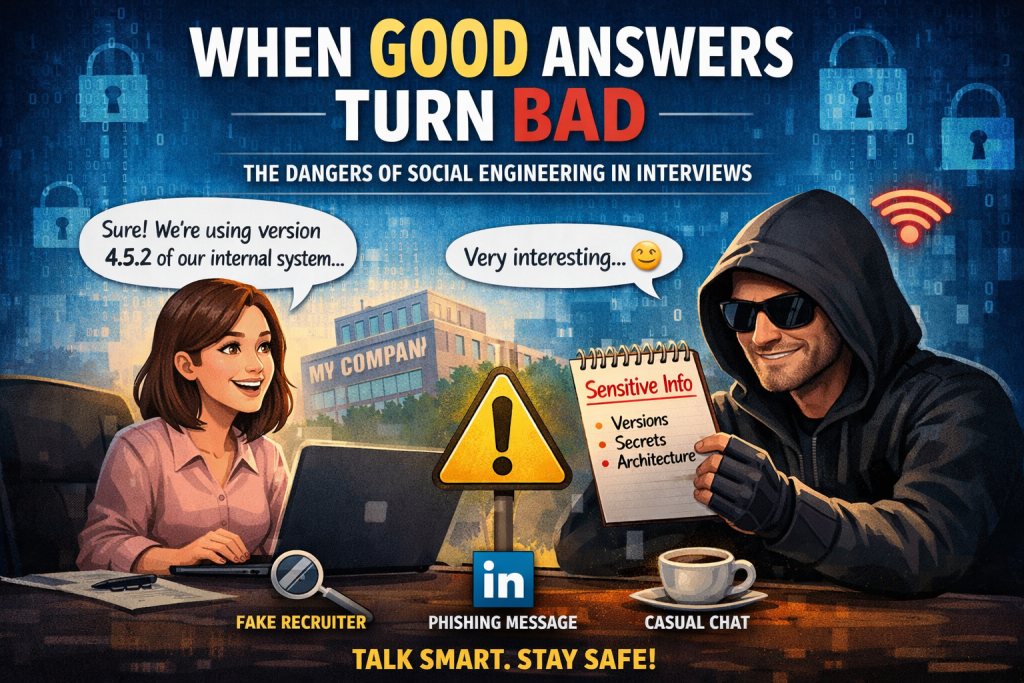
That’s when it hit me—this isn’t just an interview situation. This is a classic example of a social engineering vulnerability.
What’s the Problem Here?
Let’s be clear—there was no bad intention.
But that’s exactly how social engineering works.
Attackers don’t always hack systems.
Sometimes, they just ask the right questions… and wait.
If a simple interview question can extract internal details, imagine what a skilled attacker could do with:
- A fake recruiter call
- A LinkedIn message
- A casual “coffee chat”
Scary? A little. Real? Absolutely.
Where Do We Draw the Line?
There’s a fine line between:
- Demonstrating experience
- Exposing confidential information
A good answer should:
✔ Explain your role
✔ Highlight your skills
✔ Show problem-solving ability
But it should NOT:
✘ Reveal internal architecture
✘ Share exact versions or configurations
✘ Disclose company-sensitive data
Think of it like this:
“Explain what you do, not how your company secretly does it.”
The Interviewer’s Responsibility
This experience was also a reminder for me.
As interviewers, we should:
- Be mindful of what we ask
- Avoid pushing candidates toward sensitive disclosures
- Guide them if they overshare
Sometimes, the right response is:
“That’s great, but let’s keep it high-level.”
Because a good engineer isn’t just technically strong—
they are also security-aware.
The Candidate’s Perspective
If you’re a candidate reading this, here’s a simple rule:
If it feels like something your company wouldn’t put on their public website, don’t say it in an interview.
You can always generalize:
- “We use a monitoring tool” instead of naming internal systems
- “We handle high traffic systems” instead of giving exact scale numbers
- “We optimized performance” instead of explaining internal architecture
Trust me—interviewers are not looking for secrets.
We’re looking for how you think.
A Little Humor to Remember This By 😄
Imagine this scenario:
Interviewer: “Can you explain your experience?”
Candidate: “Sure. Also, here’s our production endpoint, credentials coming next…”
That escalated quickly. 🚨
Final Thoughts
This wasn’t a bad interview—it was a great learning moment.
In today’s world:
- Security is everyone’s responsibility
- Awareness matters more than intention
- And sometimes, knowing when to stop talking is a superpower
So next time you’re in an interview, remember:
Be impressive, not expressive with confidential data.
Stay smart. Stay secure. And maybe… keep a few secrets. 😉