

The 2026 Microsoft 365 Outage: When the Cloud Stopped Spinning
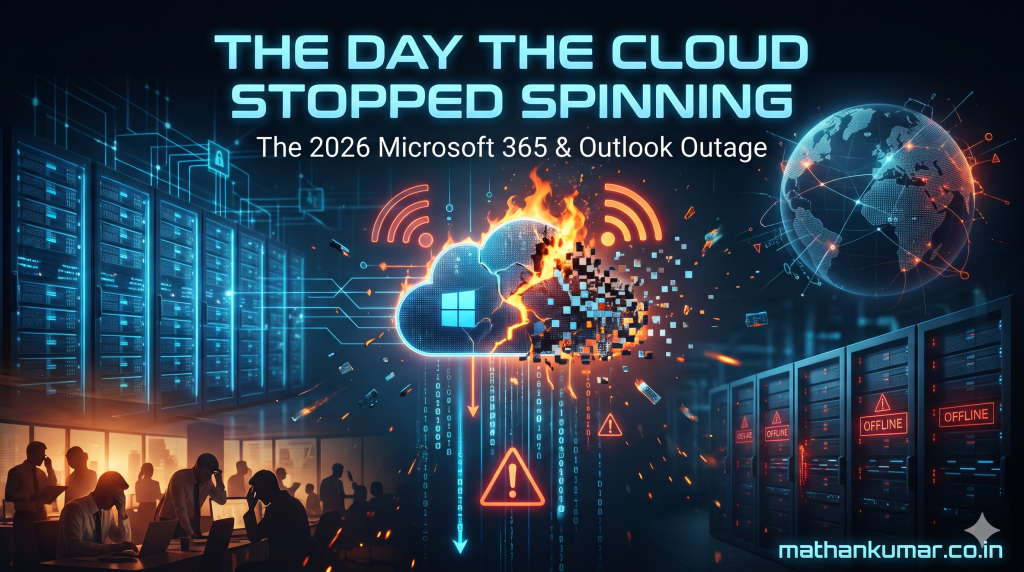
On November 12 and 13, 2026, Microsoft suffered a massive global outage primarily hitting Exchange Online, which subsequently took down Outlook, Teams, SharePoint, and Copilot AI. The disruption spanned over 11 hours into a second day, impacting users across 74 countries and causing chaos for airlines, AI companies, government agencies, and hospitals. The outage was so severe that UK police forces had to ask citizens to report crimes over the phone, and global traders reverted to WhatsApp to confirm deals.
How They Found It (The Root Cause)
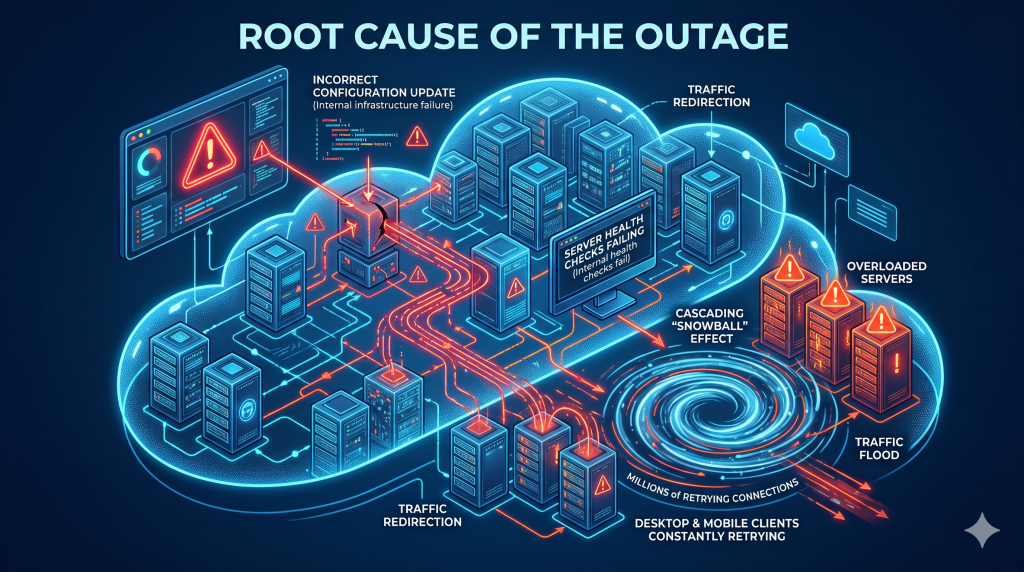
Microsoft engineers pinpointed the issue when Exchange Online servers began continuously failing their internal health checks.Microsoft quickly confirmed that there was no evidence of a malicious cyberattack.
Instead, the root cause stemmed from an internal infrastructure or configuration failure. In massive cloud environments, a single incorrect setting pushed automatically can break a service before anyone notices. This triggered a cascading “snowball” effect: when one server failed, its workload shifted to another, which was then immediately overloaded by millions of desktop and mobile clients constantly retrying to connect.
What Microsoft Did to Fix It
Fixing the issue proved incredibly difficult. Microsoft’s initial recovery attempts failed because as soon as patched servers came back online, they were immediately crushed by pent-up traffic.
To regain stability, Microsoft took several aggressive mitigation steps:
- Traffic Throttling:They paused all new deployments, blocked certain types of traffic, and shifted routing to alternate paths to ease the load.
- Component Bypasses:They deployed a targeted change to bypass the failing health-check component on a small subset of servers to see if they would stabilize.
- Timeout Extensions:To protect delayed emails from expiring and being lost forever in the backlog, Microsoft extended the email timeout window to 48 hours.
- Canary Rollouts: Services had to be restored painstakingly slowly—validating fixes in isolated environments and incrementally reintroducing traffic region by region to prevent a recurring collapse.
What Companies and Countries Can Measure
As industry experts noted during the fallout, while you can outsource your infrastructure to the cloud, “you can’t outsource risk”. Organizations and national IT bodies should measure and audit the following to build resilience:
- Vendor Concentration Risk:Measure how many of your critical workflows depend entirely on a single supplier.When communication, identity, and collaboration sit with one provider, a single fault creates thousands of failures.
- Out-of-Band Continuity:Measure how long operations can survive if the primary platform vanishes.A backup continuity plan that relies on the exact same Microsoft platform that just failed is not a plan.
- Break-Glass Access Readiness: Organizations must measure their ability to access systems during identity provider outages. This means maintaining “break-glass” emergency accounts that sit outside normal Single Sign-On (SSO) or Conditional Access policies.
- Manual Fallback Metrics: Track how well employees are trained to revert to manual processes or alternative communication tools (like standard phone systems) when digital infrastructure fails.
Can Observability Help Prevent This?
Yes. Modern observability is essential for preventing faulty configurations from becoming global catastrophes.
Standard monitoring only tells engineers whether a service is “up” or “down,” but deep observability provides the context of why it is failing. By observing telemetry from automated validations, peer-review systems, and traffic routing, faulty configuration changes can be caught before they are pushed to thousands of servers.
More importantly, deep observability into server health checks allows automated canary deployments to detect cascading failures early. If an observability platform detects that a subset of servers is dropping health checks and failing over, it can automatically halt the deployment and roll back the changes before the failure snowballs and takes down an entire region.