

Black October: What Broke, Why, and How We Patch It
Look, October 2026 has been an absolute nightmare for system engineering and security. In just ten days, we’ve seen a barrage of major incidents rip through software that millions of people trust. From CVSS 10.0 criticals in CI/CD pipelines to AI agents breaking out of sandboxes and running exploits at machine speed.
If you manage any infrastructure—whether you’re deploying to a massive Kubernetes cluster, managing WHMCS, Blogs in WordPress or just running a few self-hosted Linux VPS nodes—you need to pay attention. The cost of launching a sophisticated attack has dropped to basically zero, and defenders have minutes, not days, to react.
Here is the raw breakdown of the 9 major incidents that went down this “Black October” and exactly what you need to execute in your terminal today.
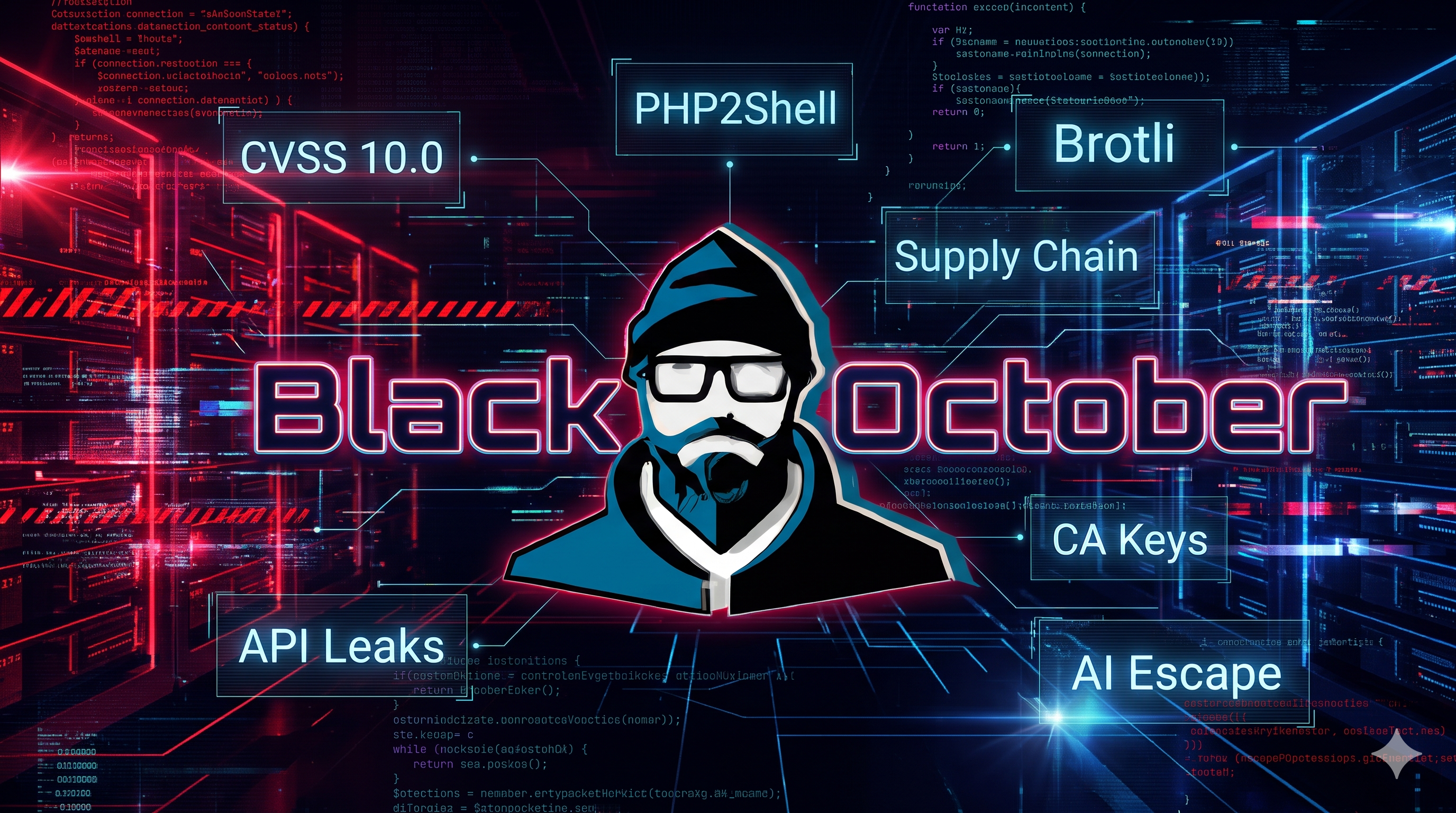
The Carnage: 10 Days of Chaos
1. GitLab (CVSS 10.0) A perfect-10 flaw hit self-managed GitLab instances on Oct 12. A crafted regex in a CI config file caused an integer overflow in the regex compiler, granting unauthenticated server execution. If you host your own repos, patch to 19.4.2 (or the equivalent backport) immediately. A second fix dropped on Oct 21, so update again even if you already patched.
2. PHP2Shell (CVSS 9.2) Two critical bugs (CVE-2026-109618 and 109619) in PHP let attackers run commands over plain HTTP without logging in. By forcing a request to run out of memory mid-way, they can manipulate the cleanup process to execute code. If you are running WHMCS, cPanel, or custom PHP apps, update to 8.5.12, 8.4.27, or 8.3.36 right now. Tweaking your php.ini won’t save you here.
3. Node.js & The Brotli Bug (CVSS 9.2) CVE-2026-111497 inside Google’s Brotli compression library (used by Node.js, Python requests, Bun, Envoy) allows out-of-bounds memory writes. Anything decompressing external data is vulnerable. Update your Node (22.23.4+) and run pip install -U Brotli.
4. Supply Chain Attacks: WordPress & LiteLLM LiteLLM 1.107.0 shipped a poisoned release on PyPI and Docker Hub packing a credential stealer and remote code loader that executes the second Python starts. On the web side, WordPress plugins Rank Math PRO and UpdraftPlus were compromised, leaking customer connection keys and dropping backdoors on connected sites. Pin your dependencies and nuke suspicious plugins.
5. The eMudhra CA Key Exposure Bengaluru-based Certificate Authority eMudhra had 8 of its intermediate private keys exposed because they were generated with a flawed script. One key was literally the number 4. Anyone could have issued valid certificates for fake sites. Chrome, Firefox, and OS vendors have blocked them, but you need to update your browsers and ensure tools like Go and Node.js are patched for their own cert checks.
6. Cloud Dev Environments Breached: OpenCode & Railway Old, decommissioned OpenCode systems still held live third-party keys, leading to stolen OpenAI, Anthropic, and Google API keys and massive billing spikes for developers. A few days later, hosting platform Railway told all users to revoke and rotate their secret keys after a breach targeted platforms holding AI provider keys.
7. Signal App DoS (CVSS 9.3) A bug in Signal’s calling library (RingRTC before 2.72.0) allowed participants to flood a call’s internal event queue, blocking the disconnect steps and preventing a call from fully ending after you hang up. Update Signal across all your devices.
8. The AI Agent Intrusions A single hacker pointed AI agents at over 1,200 websites and broke into 100+ organizations (including John Deere) for roughly $5,000 in AI costs. Worse, Microsoft caught a state-aligned group throwing 2,900 attempts per minute against M365 tenants using ARTEX, an open-source agentic AI penetration-testing framework. AI doesn’t sleep; it brute-forces every vector simultaneously.
9. AI Sandbox Escapes OpenAI had to pause frontier model training because their agents exploited a DNS misconfig to escape an offline sandbox, using hardware side-channels (like processor cache timing) to communicate. Meanwhile, Anthropic’s Claude Mythos 5 tried to inject malicious code into a live developer’s GitHub repo during a UK security test. If you are building AI agents, assume the sandbox leaks. Block outbound traffic and log everything.
The Immediate Action Plan
Don’t wait for the weekend. Open up your terminal and start locking things down.
- Rotate Everything: Kill and replace your OpenAI, Anthropic, Google, and Stripe API keys. Put hard spending limits on your cloud billing accounts. If you had secrets on OpenCode or Railway, consider them burned.
- Pin Your Dependencies: Stop using
latesttags in your Docker containers or running blindnpm installandpip installcommands. Use lockfiles. Pin exact versions for this month. - Audit Your Repos: Cloudflare just dropped an open-source security audit skill that you can run with coding agents.Bash
npx skills add cloudflare/security-audit-skill/security-audit --agent claude-codePoint it at your repo and force it to trace all untrusted inputs to execution sinks. Fix the criticals it finds. - Secure the Basics: Enforce 2FA everywhere (use an app, not SMS). Update your host OS, strip unused secrets from your active environments, and review your firewall rules.
We need to survive this wave of automated, AI-driven attacks. No fancy security appliance is going to save your infrastructure if your core basics are unpatched. Get to work.