

Full-Stack Exploitation: How Hackers Break All 7 OSI Layers
August 20, 2026
Cybersecurity

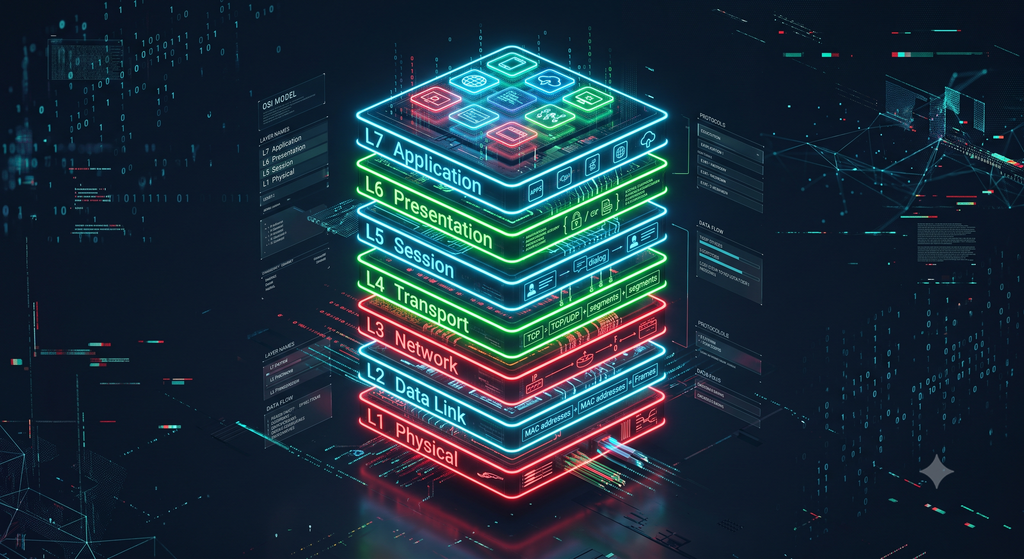
The OSI model isn’t just dry theory for certification exams—it is an active target map. If an attacker wants to compromise infrastructure, they don’t have to break down the front door; they just need to find the softest layer in the stack.
Here is the breakdown of how threats manifest across all seven layers, from physical hardware to the user-facing web.
L1: Physical Layer (The Hardware)
- The Target: Copper cables, fiber lines, server racks, and physical ports.
- Vector: Cable tapping, severed lines, or unauthorized physical dropboxes plugged into open jacks.
- Mitigation: Physical locks, port control, badge access, and perimeter security. A firewall won’t stop someone with direct physical access to the chassis.
L2: Data Link Layer (Local Switching)
- The Target: MAC addresses and local Ethernet frames.
- Vector: ARP spoofing to hijack the gateway, MAC flooding to force switches into hub mode, and local Man-in-the-Middle (MitM) positioning.
- Mitigation: Dynamic ARP Inspection (DAI), 802.1X port security, and DHCP snooping.
L3: Network Layer (Routing & Addresses)
- The Target: IP routing, packet forwarding, and ICMP.
- Vector: IP source spoofing, ping-based ICMP floods, and malicious route manipulation via BGP/routing protocols.
- Mitigation: Strict ingress/egress filtering, hardened router ACLs, and perimeter firewall policies.
L4: Transport Layer (End-to-End Delivery)
- The Target: TCP handshakes, UDP streams, and open listening ports.
- Vector: TCP SYN floods designed to exhaust connection state tables, alongside reconnaissance port scanning.
- Mitigation: SYN cookies, dynamic rate limiting, and minimal attack surface exposure.
L5: Session Layer (State Management)
- The Target: Active connections, tokens, and authentication cookies.
- Vector: Session hijacking via token theft, session fixation, and adversary-in-the-middle credential capture.
- Mitigation: Ephemeral token lifetimes, strict cookie attributes (
Secure,HttpOnly,SameSite), and immediate invalidation upon logout.
L6: Presentation Layer (Data Formatting & Cryptography)
- The Target: SSL/TLS negotiation, serialization, and cryptographic ciphers.
- Vector: SSL stripping attacks forcing plain HTTP fallback, and exploiting legacy weak ciphers.
- Mitigation: Enforcing strict HSTS policies, mandating modern TLS (1.3), and deprecating outdated cryptographic suites.
L7: Application Layer (The Human Interface)
- The Target: HTTP/HTTPS, DNS, APIs, and business logic.
- Vector: Phishing, SQL injection (SQLi), Cross-Site Scripting (XSS), and automated bot traffic.
- Mitigation: Web Application Firewalls (WAF), rigorous input validation, context-aware output encoding, and zero-trust authentication.
Security isn’t a single switch—it is defensive depth across every hop in the wire. Harden the full stack, or someone else will map it for you.
Related Posts